Research
The PhotoEC Lab develops advanced functional materials for sustainable energy conversion and storage. Our research combines electrocatalysis, photoelectrochemistry, advanced materials characterization, and operando synchrotron spectroscopy to understand structure–property relationships and design next-generation energy materials.
Electrocatalysis
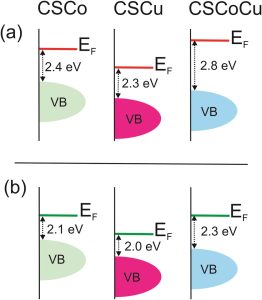
Band-edge tuning and Fermi-level modulation in photoelectrode materials.
Read publication →
We develop advanced electrocatalysts for oxygen evolution (OER), oxygen reduction (ORR), hydrogen evolution (HER), and electrochemical energy conversion processes. Our work focuses on transition-metal oxides, perovskites, spinels, and defect-engineered materials to improve catalytic activity, stability, and efficiency.
Photoelectrochemistry
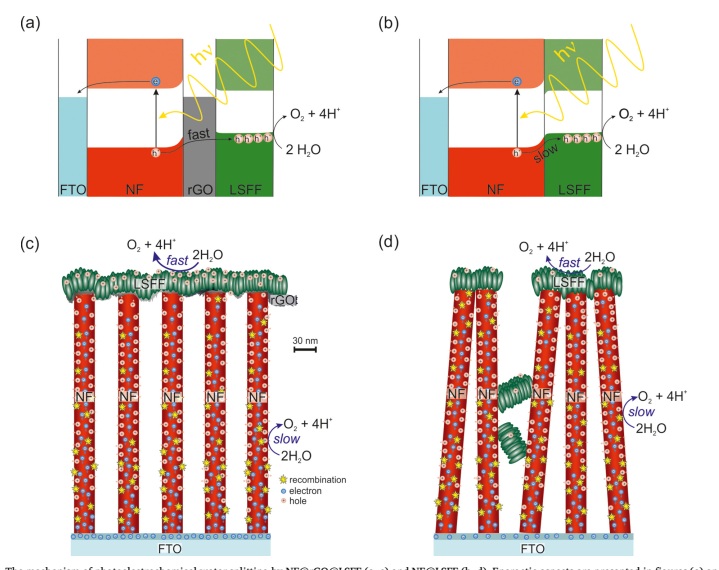
Nanostructure engineering promotes efficient charge transport and oxygen evolution in perovskite photoelectrodes.
Read publication →
Our research focuses on solar-driven water splitting, photoelectrochemical fuel production, and semiconductor-based energy conversion systems. We investigate charge-carrier dynamics, surface reactions, interface engineering, and defect chemistry to improve solar-to-fuel efficiency and long-term stability.
Advanced Materials Characterization
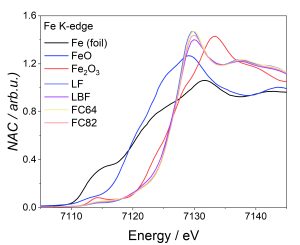
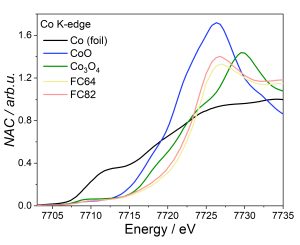
Synchrotron spectroscopy provides insights into structure–activity relationships in perovskite oxide electrocatalysts.
Read publication →
We employ advanced characterization techniques including synchrotron X-ray absorption spectroscopy (XAS), operando spectroscopy, X-ray diffraction (XRD), electron microscopy, Raman spectroscopy, and electrochemical analysis to establish structure–property relationships in functional energy material
Defect Engineering and Functional Oxides
We study oxygen vacancies, electronic structure modulation, and defect-controlled properties in perovskite and spinel oxides. Our goal is to understand how defects influence catalytic activity, conductivity, stability, and photoelectrochemical performance.